Worldbuilding · · 14 min read
What Is Worldbuilding? A Practical Guide for Writers
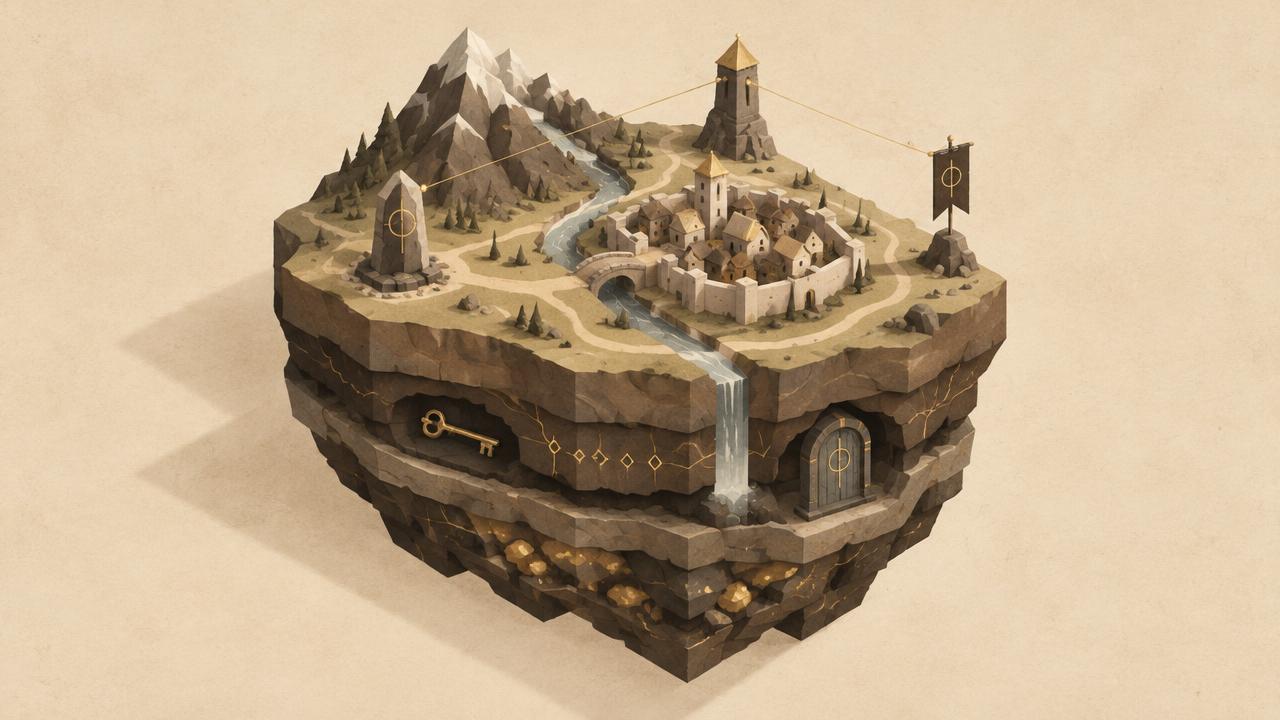
Worldbuilding is the work of deciding how an invented setting works: its land, history, power, beliefs, economy and rules, and how those things push on the people who live there. It is not the same as inventing interesting details. A detail becomes worldbuilding when it changes what a character can do, wants or fears. A city with a famous bell tower is decoration. A city where nobody may travel after the bell rings is a world, because now someone has to break the rule, bribe the watch or miss the meeting.
This guide is for novelists, game masters and anyone starting a setting from nothing. It covers where to begin, a step-by-step method, how much to show the reader, and a set of prompts you can use today. We build SAGALITH, a workspace for keeping a world and a manuscript together, and we will mention it where it is relevant to keeping track of what you decide. Everything else here works with a notebook.
TL;DR
- Worldbuilding is about consequences. Every rule, place or custom should create friction, choices or cost for someone.
- Start from the story you want to tell, not from a blank continent. Build what the next scene needs, then widen outward.
- Separate hard and soft elements. Geography and rules are fixed constraints; culture, rumours and opinions can vary between characters.
- Show the tip of the iceberg. Know more than you write, but only put on the page what a scene actually uses.
- Write decisions down in one place, so the world you build in chapter one still holds in chapter thirty.
Table of Contents
- What is worldbuilding?
- Why worldbuilding matters to a story
- The building blocks of a world
- How to start worldbuilding: top-down or bottom-up
- How to worldbuild in six steps
- The iceberg: how much to show
- 12 world building prompts that create story
- Where to find world building ideas
- Common worldbuilding mistakes
- Keep your world consistent as it grows
- FAQ
What is worldbuilding?
Worldbuilding (also written world building or world-building) is the process of constructing an imaginary setting with enough internal logic that a story can happen inside it. The word is most associated with fantasy and science fiction, but every story does a little of it. A crime novel set in an invented town still needs to know who runs the police and which streets are unsafe at night. A secondary-world fantasy simply has to decide far more, because the reader cannot fill the gaps from their own experience.
A useful definition has three parts:
- The setting has rules. Physical rules (geography, climate, magic, technology) and social ones (laws, customs, taboos).
- The rules have causes. The river city is rich because it controls the only crossing. The church is powerful because it keeps the calendar.
- The rules have consequences for characters. Someone benefits from each rule and someone pays for it.
If you only have the first part, you have a list. If you have all three, you have a place where events make sense and conflict grows on its own.
Why worldbuilding matters to a story
Good worldbuilding does three jobs for the story. It makes events believable, because readers accept surprising things when they follow from rules they have seen. It creates conflict, because limits and inequalities give characters something to push against. And it gives the book a texture of its own, so it does not read like every other book in the genre.
Take a small example. Say the river through your capital freezes solid for three months every winter. On its own, that is weather. Follow it through and it becomes story: the ferry guild loses its income every winter and resents the bridge-builders; smugglers walk across the ice at night; the city's oldest festival celebrates the thaw, and the year the ice stays too long, people start blaming the new queen. One physical fact has produced a faction, a crime, a holiday and a political crisis. That is what worldbuilding is for.
The reverse is also true. Worldbuilding that never touches the plot tends to show up as long passages the reader skims. The test is simple: if you removed this detail, would any scene have to change?
The building blocks of a world
Most settings can be described with the same handful of areas. You do not need all of them on day one. Use the list to notice what your story depends on.
| Area | Key questions | Story it can create |
|---|---|---|
| Geography and climate | What does the land look like? What is scarce? How do people travel? | Journeys, borders, famine, trade routes |
| History | What happened that people still argue about? | Grudges, inheritances, lost knowledge |
| Power and politics | Who rules, how, and who wants it instead? | Rebellion, intrigue, loyalty tests |
| Economy and trade | What is valuable, and who controls it? What do people pay with? | Debt, smuggling, class tension |
| Belief and religion | What do people believe happens after death? Who speaks for the gods? | Heresy, pilgrimage, moral dilemmas |
| Magic or technology | What can it do, what does it cost, who has access? | Advantages, accidents, arms races |
| Daily life and culture | What do people eat, wear, celebrate and fear? | Belonging, outsiders, ritual scenes |
| Names and language | How are people and places named, and what does a name reveal? | Status, ancestry, mistaken identity |
It helps to sort these into hard and soft elements. Hard elements are facts every character would agree on: the mountains are there, the year has fourteen months, a spell costs blood. Keep them fixed, or readers stop trusting the world. Soft elements are things people disagree about: whether the old king was a tyrant, what the ruins were for, which god is real. Let those vary between characters. A world where everyone holds the same opinion about its history feels like an encyclopedia; a world where they argue feels inhabited.
For magic specifically, Brandon Sanderson's First Law of Magic is a good check: "an author's ability to solve conflict with magic is directly proportional to how well the reader understands said magic." His second law adds that limitations are more interesting than powers. So if magic will save the day at the climax, establish its costs and limits early. If it stays mysterious, use it to create problems rather than solve them. Our magic system template walks through source, cost, limits and who has access.
How to start worldbuilding: top-down or bottom-up
There are two common ways in, and both work.
Top-down starts large: a continent, its nations, its history, then down to a city and finally a character. It suits writers who enjoy systems and want everything to fit together, and it is common for game masters building a campaign setting. Its risk is that you can spend months on the map before you know what the story needs from it.
Bottom-up starts small: one character, one scene, one street. You invent only what that moment needs, then ask what must be true for it to make sense, and widen outward from there. It keeps every invention attached to the story. Its risk is that early decisions made in a hurry can clash later, so you need to write them down as you go.
If you are not sure which suits you, start bottom-up and borrow one top-down habit: before you write, decide the two or three biggest forces in the world (a dominant power, a scarce resource, a recent catastrophe). Then build outward from your first scene with those forces already in place. Tolkien famously began with invented languages. In a 1955 letter he wrote that the stories were made rather to provide a world for the languages than the reverse. Most writers will find it more practical to begin with a character in trouble.
How to worldbuild in six steps
This is a method you can run in an afternoon and keep extending as the draft grows.
1. Write the premise in two sentences
Who is the story about, what do they want, and what stands in the way? Everything you build should serve that conflict first. A disgraced ferry pilot wants to reclaim her guild licence. The only way to do it is to guide a fugitive across the frozen river the queen has closed.
2. List what the first chapter needs
Look at your opening scene and write down every setting fact it depends on: who is allowed where, what things cost, what time of year it is, who the characters answer to. Those five to ten facts are your first worldbuilding, and they matter more than anything on the far side of the map.
3. Pick the core forces
Choose a small number of large-scale facts that shape everything else. A good set is one resource (what is scarce), one power (who controls it) and one wound (a past event people still feel). In our example: the river crossing, the crown that taxes it, and the winter the ice broke under an army.
4. Follow each fact to its consequences
For every fact, ask "so what?" three times. The river freezes. So what? The ferry guild loses income. So what? They lobby to ban crossing the ice. So what? Crossing the ice is now a crime, and your protagonist is about to commit it. This one habit turns a list of details into a web of cause and effect.
5. Give the world a point of view
Decide how different groups see the same facts. The guild calls the ice ban public safety; the poor call it a toll on walking. A believable world contains disagreement, and characters reveal themselves through which side they take.
6. Write the rules down, then write the story
Record what you decided where you can find it: the calendar, how names work, what magic costs, what is officially true. Then go back to the draft. Return to worldbuilding when the story asks a question you cannot answer, not before. If you want a structured starting point, the free worldbuilding template and worldbuilding checklist cover these areas without asking you to fill in everything at once.
The iceberg: how much to show

Writers often borrow Ernest Hemingway's iceberg theory here. In Death in the Afternoon (1932) he argued that the visible part of a story should rest on a much larger body of knowledge the reader never sees. In worldbuilding, it means you should know why the guild hates the bridge-builders, but the reader might only see a pilot spitting at a stonemason. The history sits underneath and makes the moment feel solid.
A few ways to keep the tip small:
- Reveal through action and conflict. A custom is more memorable when a character breaks it than when the narrator explains it.
- Let characters take things for granted. People do not explain their own world to each other. If a detail would be obvious to the speaker, let it stay implied.
- Explain only at the moment of need. Introduce the ice ban when the protagonist is about to break it, not in the prologue.
- Use one precise detail instead of three general ones. A copper coin with a hole punched through the queen's face says more about politics than a paragraph about unrest.
The opposite failure has a nickname: worldbuilder's disease, the habit of building forever and never writing the story. The novelist M. John Harrison, in a 2007 blog post, called worldbuilding "the attempt to exhaustively survey a place that isn't there" and criticised the urge to show the reader all of it. You do not need to agree with him to take the warning. If you have more pages of lore than pages of draft, the next thing to build is a chapter.
12 world building prompts that create story
Generic prompts ("describe your world's religion") produce encyclopedia entries. These ask about tension, and each one should give you at least one scene.
- What is a luxury in this world that would be free or cheap in ours, and who controls it?
- Which law does almost everyone break quietly, and what happens to the person who gets caught?
- What do children learn to fear before they can read?
- Which historical event do two neighbouring groups remember completely differently?
- Who in this society is powerful but invisible, such as a clerk, a midwife or the person who keeps the maps?
- What job is necessary but despised, and who does it?
- What is the last thing that changed everyone's daily life, and who still resents it?
- What would a traveller from the next country find rude here?
- Where do people go when they want to disappear?
- What does magic or technology cost the person who uses it, and who pays that cost instead when someone rich uses it?
- What does this culture name its children after, and what does an unusual name signal?
- What is the official story of how the current rulers took power, and what is the true one?
Answer them in your character's voice instead of the narrator's, and you will often get dialogue you can use directly.
Where to find world building ideas
Original settings rarely come from nowhere. They usually come from combining things in a new way. Some reliable sources:
- Real history, transplanted. Medieval guild politics, Bronze Age trade networks, the economics of salt or spice. Take the structure, change the surface, and look at what breaks.
- Ecology first. Start with a strange environment, such as a desert of glass, a sea that retreats for a year, or a forest that only grows in burnt ground. Then ask how people would survive there and what they would fight over.
- Invert a familiar trope. The elves are the newcomers. The dark lord won and is now struggling with administration. The prophecy was forged.
- Combine two unrelated ideas. Monastery and bank. Lighthouse and prison. Courier service and religion. The friction between them is the setting.
- Follow the money. Ask who profits from the way things are. That person is your antagonist, ally or both.
Generators can help you get unstuck on smaller pieces. Our free fantasy name generators, world generators and magic system generator produce raw material for names, towns and spells. Treat their output as suggestions to argue with. The useful part is deciding which result fits your world, and why.
Common worldbuilding mistakes
- Building everything before writing anything. Momentum matters. Build what you need, write, then build more.
- Monocultures. One planet, one climate, one personality per species. Real places contain regions, classes, generations and dissenters.
- Rules without costs. Magic, technology or privilege that costs nothing removes tension. Decide who pays.
- History that stops at the present. Characters should be living through change, not standing at the end of a finished timeline.
- Info dumps. Long explanations in the narrator's voice usually mean the scene has no conflict to carry the information.
- Forgetting what you decided. A calendar with twelve months in chapter four and thirteen in chapter twenty is a quick way to lose a reader's trust. Our guide on building a fantasy calendar covers that specific problem.
Keep your world consistent as it grows
Once a world grows past a few dozen facts, memory stops being reliable. The solution is a story bible: one reference that holds characters, places, events and rules, kept up to date as the draft establishes new facts. The guide How to build a story bible explains how to structure one so you can actually maintain it.
What matters most is that each kind of fact has an obvious home. Biography belongs with the character, geography with the place, chronology on a timeline, and the world's fixed rules, such as the calendar, naming conventions, currency and what magic can and cannot do, in one place you check before writing.
In SAGALITH, that last part is the World Codex, which sits at the top of each world's database. Characters, places and factions are linked entries, the timeline and maps sit beside them, and chapters are written in the same workspace, so you can look up a rule without leaving the sentence. The free plan includes every tool, and AI is optional; if you do use it, the AI helpers follow the rules you wrote in the Codex. If you are comparing options, our guide on choosing worldbuilding software has a short test you can run in any tool, including a plain document.
FAQ
What is the difference between worldbuilding and setting?
Setting is where and when a story takes place. Worldbuilding is the work of inventing and connecting the rules behind that setting. Every story has a setting; worldbuilding is how you construct one that is not simply borrowed from the real world.
How much worldbuilding do I need before I start writing?
Enough to write the first chapter with confidence: the premise, the core forces, and the facts your opening scenes depend on. Many writers continue worldbuilding alongside the draft and revise early chapters once the world has settled.
Do I need a map?
Not always, but it helps whenever travel, distance or borders matter to the plot. Start with the region the story actually covers. Our guide to planning a fantasy map shows how to build one around the journey your story needs.
Is worldbuilding for a novel different from worldbuilding for D&D?
The principles are the same, but the emphasis shifts. A novelist controls what the reader sees and can keep most of the world hidden. A game master has to be ready for players to go anywhere, so breadth matters more, and quick improvisation tools like NPC and town generators earn their place.
Can AI help with worldbuilding?
It can be useful for brainstorming alternatives when you are stuck, as long as you keep the final decision. Give it the constraints that already exist, ask for several options, and adopt only what fits. Our guide on using AI for worldbuilding without losing your voice covers a workflow for that.
Worldbuilding is not a stage you finish before the real writing begins. It is a set of decisions you keep making, each one judged by whether it gives your characters something to want, fear or fight over. Start with one rule that costs someone something, follow it to its consequences, and write the scene where it bites.