Worldbuilding · · 12 min read
Science Fantasy: Meaning, Examples and How to Build One
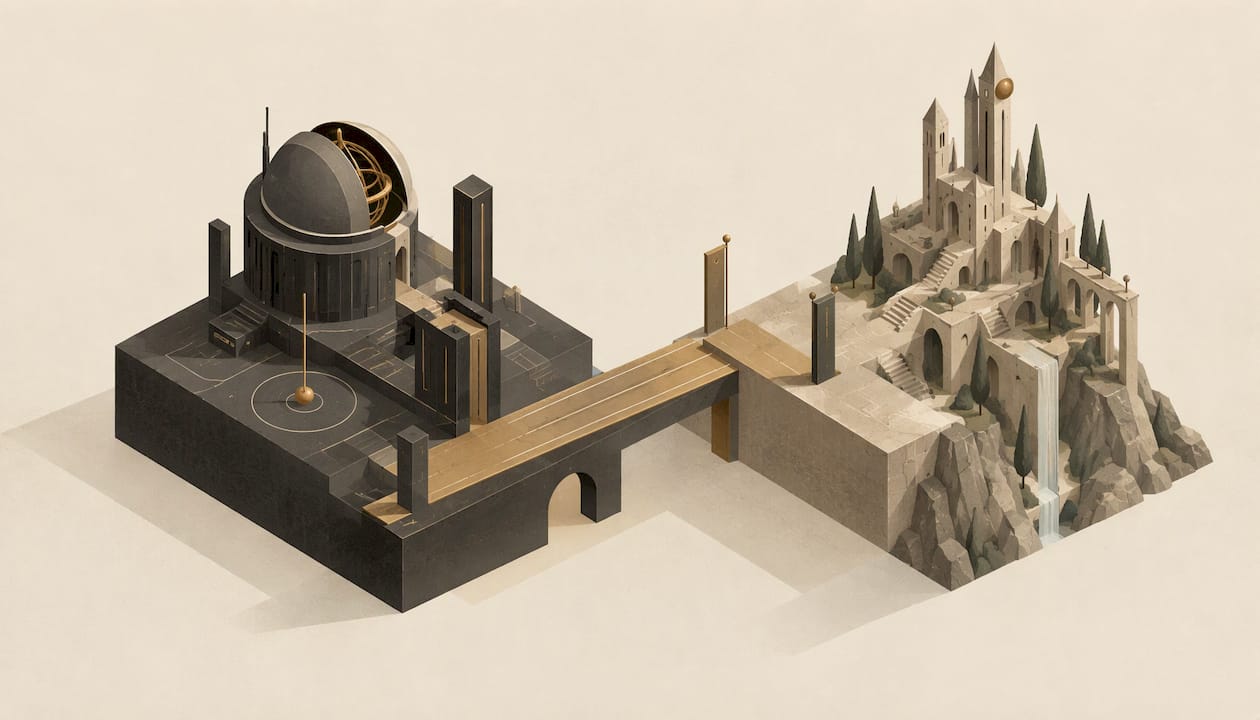
Science fantasy is a genre that blends science fiction and fantasy: starships beside swords, blasters beside spells, a far-future setting with a mythic soul. The hard part for a writer is not the mix. It is keeping the rules of two kinds of worlds from contradicting each other across hundreds of pages. That is a record-keeping problem as much as a creative one, and a story bible where every character, power, machine and place is linked solves it. That is what we built SAGALITH to be.
TL;DR
- Science fantasy combines the trappings or the ideas of science fiction and fantasy, and none of the usual motifs (parallel worlds, psi powers, gods, monsters) is mandatory.
- Space opera is a close neighbor: large-scale, romantic, interstellar adventure. It overlaps with science fantasy but is not the same label.
- The most reliable way to make the mix feel coherent is to trace magic and technology back to one underlying system, or to make their clash the plot.
- Whatever you choose, write the rules down and link them to the characters, places and scenes that depend on them.
Table of Contents
- What science fantasy means
- Science fantasy vs. science fiction vs. fantasy
- Where space opera fits
- Examples worth studying
- Build a world where magic and technology agree
- The sensory layer: names, ships and sound
- Why science fantasy breaks continuity, and how to prevent it
- Starting from a template
- Where SAGALITH fits
- A short checklist before you draft
- FAQ
- Sources
What science fantasy means
The Encyclopedia of Science Fiction describes science fantasy as a genre blending elements of science fiction and fantasy. It lists common motifs, including parallel worlds, other dimensions, ESP, monsters, psi powers and supermen, but says none of them is essential. The stories may also include magic, gods, demons, heroes, mythology or supernatural creatures, often in a quasi-rationalized form. Many examples are planetary romances (adventures on other worlds) or Dying Earth tales (stories set in the far twilight of a planet, where science and magic blur).
The label has also shifted over time. The same entry records that early on, "science fantasy" was sometimes used as a synonym for science fiction, including a 1931 reference and a 1939 UK fanzine subtitle. So if an old book calls itself science fantasy, it may only mean sci-fi.
Aesthetics or ideas?
Author Django Wexler argues in Locus that science fantasy usually blends the recognizable trappings of the two genres, such as starships, robots and blasters alongside swords, knights and magic, rather than necessarily blending their subjects or themes. That distinction is useful when you plan. You can mix surface elements and keep the story's concerns in one tradition, or you can let the two traditions argue with each other at the level of theme. Both are science fantasy. Decide which you are writing before you draw the first map.
Science fantasy vs. science fiction vs. fantasy
The textbook split is simple. Science fiction explains its wonders through science, or at least through something that behaves like science. Fantasy accepts wonders that science cannot explain, and gives them their own internal logic. Science fantasy sits where both claims are made at once.
A few practical ways to tell them apart in your own manuscript:
| Question | Science fiction | Fantasy | Science fantasy |
|---|---|---|---|
| Where does the impossible come from? | Extrapolated science | Magic, gods, the supernatural | Both, or one source dressed as the other |
| What does the setting look like? | Futuristic | Pre-industrial or mythic | Futuristic and mythic together |
| How are the rules treated? | Mechanistic and testable | Costly, symbolic, personal | Either, as long as you commit |
The boundaries are blurry on purpose. Wexler points to Star Wars as the clearest widely familiar example, because it combines starships, robots, blasters, knights, magic and a hero-journey structure. Some readers file it under space opera, some under science fantasy, and some under fantasy with technology. All three answers are defensible, and that is why you, not the label, should define your rules.
Where space opera fits
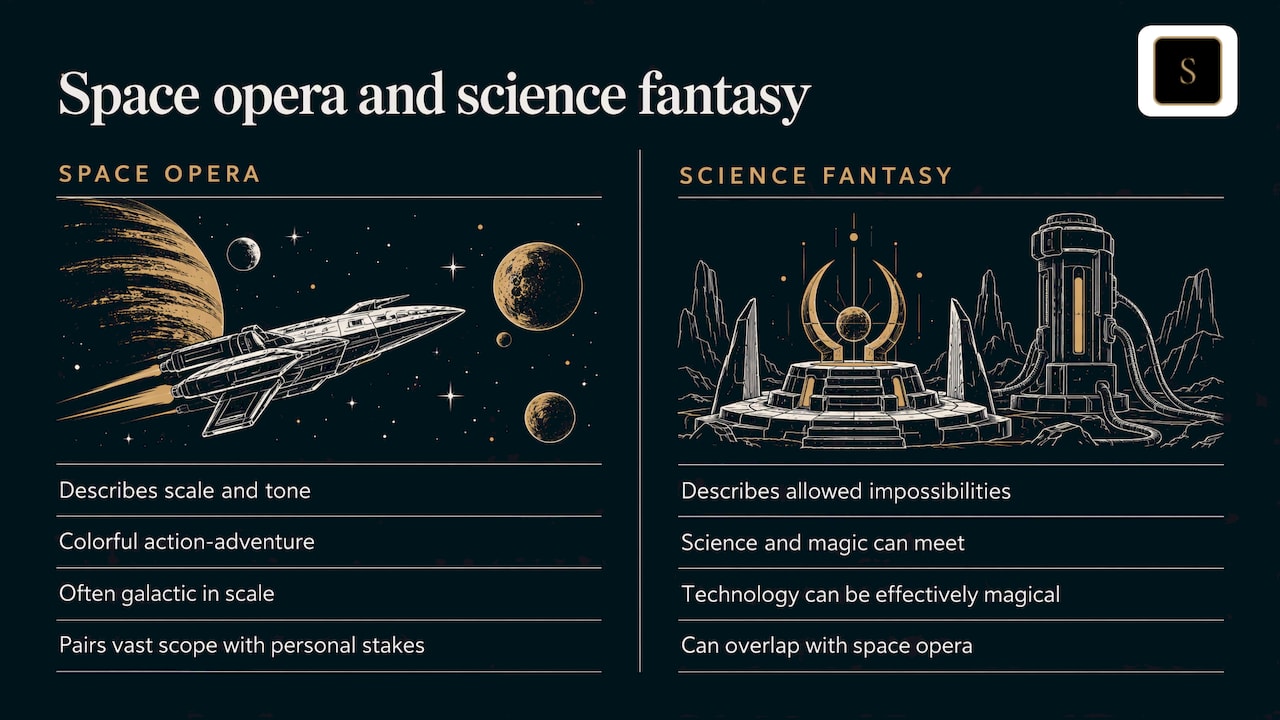
Space opera is the other term readers ask about, and it overlaps with science fantasy more than it competes with it. The Encyclopedia of Science Fiction defines it as colorful, romantic action-adventure involving interplanetary or interstellar conflict. The term began in 1941 as Wilson Tucker's disparaging label for a hackish spaceship story, and it was modeled on earlier "horse opera" and "soap opera." It still carries a faint trace of that history but is often used affectionately.
A 2025 Writers Chronicle guide to teaching genre fiction puts it as the science-fiction equivalent of epic fantasy: usually large in scale, often galactic, with life-and-death stakes for characters and civilizations. It adds that effective space opera pairs enormous scope with deeply personal stakes, and that the technology can be either somewhat plausible or effectively magical.
That last point is where the genres meet. Space opera describes scale and tone. Science fantasy describes what kind of impossible things are allowed. A story can be one, the other, or both: an empire spanning a hundred star systems, ruled by a priesthood whose rituals really do bend reality, is both.
Examples worth studying
If you are writing in the genre, read it first. The Encyclopedia of Science Fiction names a long list of authors important to science fantasy, including Marion Zimmer Bradley, Edgar Rice Burroughs, L. Sprague de Camp, Samuel R. Delany, Anne McCaffrey, Andre Norton, Jack Vance, John Varley, Roger Zelazny, Gene Wolfe, Joan D. Vinge, C. L. Moore and Henry Kuttner, and it highlights John Crowley's The Deep.
Wexler also describes his own novel Ashes of the Sun as science fantasy because it combines swords and melee combat with magic, energy weapons, flying ships, robots, atomic weapons, genetic manipulation and transporters.
The genre is not only an Anglo-American print tradition. The New Routledge Companion to Science Fiction (2nd edition, 2024) widens its coverage to South Asian, Latin American, Chinese and African-diasporic science fiction, as well as games and other media. For a game master, that is a reminder that tabletop and video games are a major home of science fantasy, and for any writer it is a reason to look beyond the usual canon for ideas.
What you want from your reading is not plot but architecture. For each work, ask what the source of the impossible is, who can use it, what it costs, and what the story does when magic and machines meet.
Build a world where magic and technology agree
The research on how to combine the two points to two workable strategies.
Strategy one: one source for everything
In Ashes of the Sun, Wexler makes magic the underlying power behind both magical abilities and things that look technological, such as skyscrapers, flying ships and blasters. The story's metaphysics stays consistent because there is one explanation. Instead of inventing a separate exception for every spectacular effect, you ask a single question each time: how does the one source produce this?
A Mythcreants guide for creators describes the same idea in two flavors: advanced technology mistaken for magic, or technology that runs on magic.
Strategy two: make the contrast the plot
The same guide suggests a second route: keep the two systems separate and make the difference central to the story. Technology might suppress magic, or characters might cross between a science-fiction world and a fantasy world. Here the rules do not need to merge, but the border between them needs exact rules, because that border is where your scenes happen.
Turn the choice into rules you can check
Whichever route you choose, write it down in a form you can test a scene against. For each power or machine, decide:
- Source. Where does it come from, and is it the same source as other powers?
- Cost. What does it use up: fuel, life, memory, favors, time?
- Limits. What can it never do, and what does it fail against?
- Access. Who can use it, who is forbidden, and who has been lying about it?
- Interaction. What happens when it meets the other system?
A magic system template walks you through the first four, and the magic system generator is a quick way to get rules, costs and limits on the page when you are stuck. In a science fantasy, run the same questions on your technology. A starship drive with no cost and no limit is as much a plot hole as a wizard with infinite mana.
The sensory layer: names, ships and sound
Because science fantasy leans on recognizable trappings, the surface details matter. A fleet needs ship names with a consistent flavor, and a crew needs names that sound like they came from the same culture, whether that culture is a monastic order or a mining consortium. Our spaceship name generator and sci-fi name generator give you starting points, and the god name generator covers the mythic half of the mix. Use them to find a direction, then edit until the names match the culture you built.
If you are making a game, the same blend applies to sound. Technology and fantasy motifs side by side, the way Star Wars pairs them, are easier to sell with the right effects, and a spaceship sound effect generator built for RPG Maker projects can give a sci-fi layer to a fantasy engine.
Why science fantasy breaks continuity, and how to prevent it
A straight fantasy has one rulebook. A science fantasy has at least two, plus the places where they overlap. That multiplies the ways a long project can go wrong:
- A character who could not use a power in book one uses it freely in book three.
- A ship that took a month to cross a gap in one chapter does it in a day in another.
- A faction's origin story changes between the timeline and the wiki you shared with your players.
- A technology that was meant to be rare shows up on every street corner because a note went missing.
None of these come from bad ideas. They come from facts living in different places: a notes app, a spreadsheet, a map file, a draft. The fix is one connected workspace where each fact has a home and everything that depends on it points back to it.
What that looks like in practice
Take the rules you wrote above and give each its own entry. Link the entry for your core power source to every character who uses it, every artifact built on it and every kingdom or fleet that depends on it. When you change a cost, you see everything the change touches. Add a timeline so you can see which discoveries come before which wars, and a character database so a hero's training history matches what the story lets them do on the page. Our free story timeline planner is a quick way to sketch the order of events before you commit.
If your world has its own calendar, which a far-future or Dying Earth setting often does, our guide to building a fantasy calendar covers how to make one that holds up.
Starting from a template
If you do not want to open software yet, begin with a page. A free worldbuilding template will prompt you through geography, history, cultures and power. A story bible template is the right size if you are planning a series. Fill them in for the fantasy half and the science half separately, then write one paragraph on how they connect. If you cannot write that paragraph, you have found your first plot problem, and it is cheaper to find it now than in the second draft.
Where SAGALITH fits
SAGALITH combines lore management, a character database with visual identity tools, fantasy map creation and linking, family trees and timelines, consistency checking and an integrated manuscript editor in one workspace. For a science fantasy, that means your magic rules, your ship classes, your maps and your chapters can all point at each other. You can also publish a public wiki of your world, and AI-driven brainstorming is available for every story component. It is always optional, so you review whatever it suggests and stay in control of the canon.
Every tool is on every plan. The Wanderer plan is $0 per month, Chronicler is $9 per month and Archon is $19 per month, so Wanderer gives you up to 2 worlds and 50 AI credits a month, and the paid plans add unlimited worlds and more monthly AI credits. Exporting your work is always free, so your world and manuscript are never locked in. See the plans on the pricing page, or read more about our story bible software.
A short checklist before you draft
- Write one sentence naming the genre mix: "a far-future empire where [technology] runs on [magic source]."
- Decide whether you are blending aesthetics, ideas, or both.
- Define source, cost, limits, access and interaction for each power and each major technology.
- Name the two or three scenes where the two systems collide, and make sure the rules decide the outcome rather than the author's convenience.
- Link everything: characters, places, artifacts, factions, events.
- Re-read your rules after each draft and fix the entries, not only the chapters.
FAQ
What is science fantasy in simple terms?
It is a story that mixes science fiction and fantasy, for example with spaceships and swords, or technology and magic in the same world. The mix can be only in the surface details or it can run through the themes. No single ingredient is required.
What does space opera mean?
Space opera is large-scale, colorful, romantic adventure involving conflict between planets or star systems. The term began in 1941 as a mild insult and is now often used with affection. It describes scope and tone, so a space opera can be science fiction, science fantasy or both.
Is Star Wars science fiction or fantasy?
It is the example most often used for science fantasy, because it combines starships, robots and blasters with knights, magic and a hero's journey. Some people call it space opera instead. Which label fits depends on whether you weigh its look or its themes.
How do I keep magic and technology consistent in one world?
Either trace both back to a single underlying source, or make the difference between them the center of your plot. Then record each power's source, cost and limits, and link them to every character and place that depends on them, so a change shows up everywhere it matters.
Sources
- SFE: Science Fantasy
- SFE: Space Opera
- Django Wexler Guest Post, "Science Fantasy", Locus
- A Field Guide to Teaching Genre Fiction, The Writer's Chronicle
- The New Routledge Companion to Science Fiction, 2nd edition
- Mythcreants: How Can I Combine Fantasy and Science Fiction Elements?