SAGALITH / Novel planning software
Novel planning software from first beat to final chapter
Move from a promising premise to a chain of turning points. SAGALITH keeps your beat sheet, your character's arc and your chapters on the same book, so the plan can change as the story grows.
Every tool included. Free exports on every plan.
What a plot planner should help you decide
A useful outline explains why the next event happens, not just what happens next. For each turning point, decide what the main character wants, what blocks them and which choice changes their options.
Use your novel planner to test the chain of consequences before polishing scenes. If removing a beat changes nothing later, it needs a stronger consequence, or it belongs in your notes instead.
- Give the central conflict an outcome the reader can recognise.
- Make each major reversal change what the main character can do next.
- Connect the ending to a choice the character at the opening could not yet make.
Choose a beat sheet that fits the story
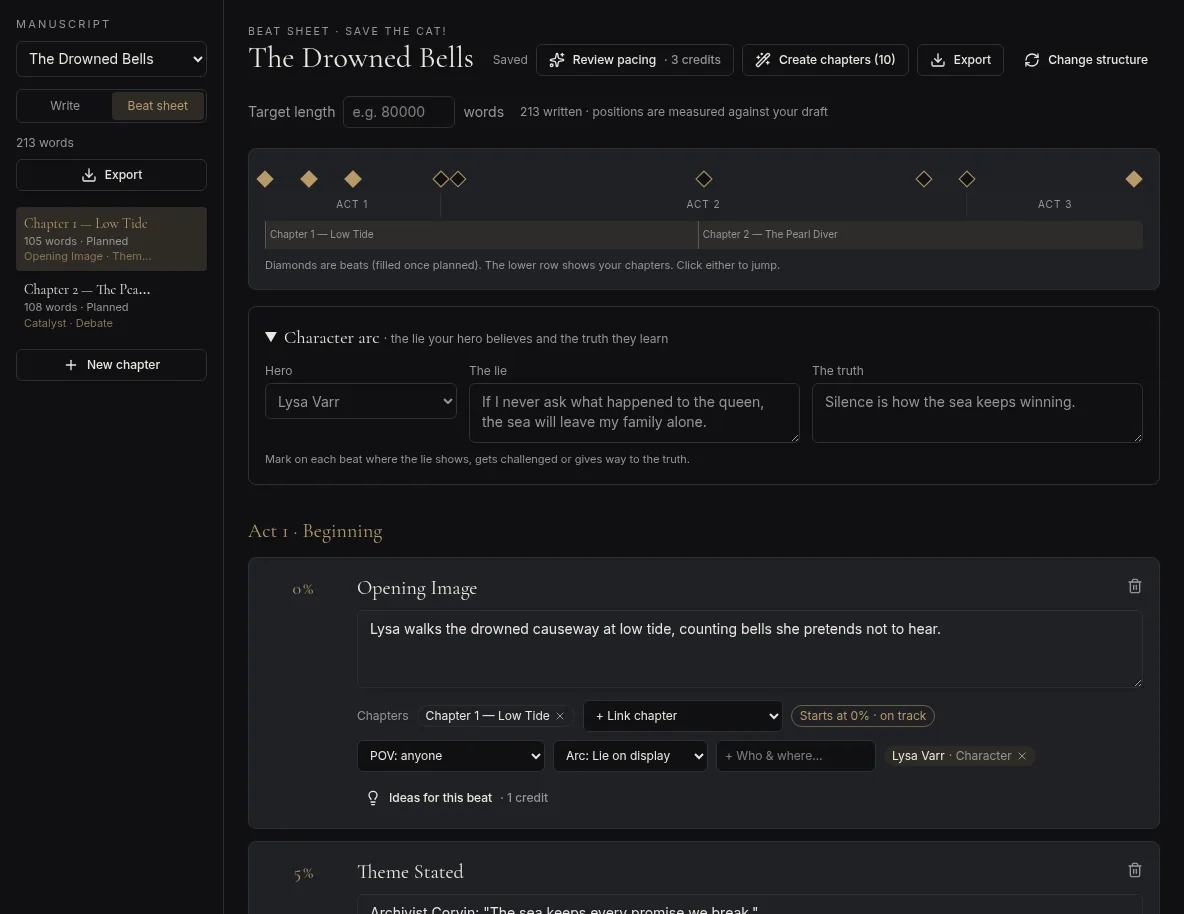
SAGALITH has four starting structures. Pick the one that helps you ask better questions; the positions are guides, not rules your novel has to obey. You can switch structure later and keep your hero's lie and truth.
- Save the Cat: 15 beats, from Opening Image to Final Image, with prompts for the catalyst, midpoint and finale.
- The Hero's Journey: 12 stages, from the Ordinary World to the Return with the Elixir.
- Three-act structure: seven key moments, from the inciting incident through two plot points and the midpoint to the climax and resolution.
- Free form: start with a beginning, middle and end, then add, rename and move beats to suit your story.
Check pacing against the chapters you write
Link chapters to the beats they deliver. SAGALITH uses each chapter's word count to work out where it sits in the book and compares that with the beat's planned position, so a midpoint that arrives at 30% is flagged as early. The flag is a prompt to look, not a verdict on the scene.
A midpoint planned at 50% falls around 40,000 words into an 80,000-word novel. If its chapters land much earlier, decide whether the reversal needs more setup or whether the plan should move. Until the draft reaches its target length, positions are measured against the target.
Let the character arc drive the plot
Write down the false belief your main character starts with and the truth they need to learn, then mark the beats where the lie shows, where it is challenged and where it finally gives way. Seeing those marks beside the plot shows whether the outer events are actually changing the person.
A cartographer who believes that asking for help is weakness might hide a dangerous mistake early on. A later reversal forces her to trust a rival, and the final choice shows the change instead of announcing it.
Turn planned beats into chapters
Write a short note for each beat: the pressure, the choice and the consequence. When you are ready, Create chapters makes one chapter for every beat that doesn't have one yet, in story order, with the beat's notes as the chapter outline.
Treat that first chapter list as scaffolding. A turning point may need several chapters, and one chapter can serve two beats; link existing chapters where they belong instead of creating duplicates.
Organize the book into parts and acts
Long novels often fall into parts or acts. Add a part or act in the manuscript and its chapters are grouped under a heading such as Part One or Act II: The Salt Road. Chapter numbers follow reading order, and Word, EPUB and Markdown exports start each part with its own heading.
Already drafting in Word? Import chapters splits a Word, Markdown or text manuscript at its chapter headings, turns part headings into parts and keeps bold and italic text, so you can link the chapters to your beats straight away.
Plan ahead, or outline what you discover
If you like to plan, map the major reversals before drafting. If you find the story by writing, start with the next important choice and update the beat sheet every few chapters.
A story planner for writers should support both. During revision, link the chapters you have to the beats they actually deliver and compare that with what you intended. The gaps often point to a missing setup, a dropped promise or an ending that needs a different beginning.
Keep the plot beside the world it happens in
A story bible records what is true about the world; a plot plan records what changes and why. In SAGALITH each beat can link the characters, places and historical events involved, so when a magical bargain limits the climax, the rule is one click away from the beat that depends on it.
The beat sheet lives on the book, next to its manuscript, and the chapters stay the only home of your text. Optional AI tools can review pacing or suggest ideas for a beat, but nothing changes unless you accept it.
Your first three steps
- 01
Pick a structure for your book and write a line for the inciting incident, the midpoint and the ending.
- 02
Fill in your hero's lie and truth, then mark the beats where the arc turns.
- 03
Link chapters you have, or create chapters from the beats, and check pacing as the draft grows.
Before you begin
Is the beat sheet free?
Yes. The beat sheet, chapter links, pacing checks and character arc are included on the free plan and use no AI. The optional AI pacing review and beat ideas use AI credits.
Do I have to use Save the Cat?
No. Choose the Hero's Journey, three-act structure or free form instead, and rename, add or move beats on any of them.
Can I use it after I've started drafting?
Yes. Import your draft from Word or Markdown and it is split into chapters, or keep writing in SAGALITH. Link the chapters you have to the beats they deliver and use the sheet as a reverse outline. The pacing check compares where those chapters sit with where each beat was planned.
How is this different from a story bible?
A story bible is the reference for characters, setting and continuity. A novel plan is about conflict, turning points, pacing and character change. SAGALITH keeps both in the same world, beside the manuscript.