Worldbuilding · · 13 min read
Fantasy Calendar: How to Build One That Holds Up
A good fantasy calendar is small, built from a few facts your story actually uses, and stored where you can check it every time a date appears. Choose the year length, the way days are grouped, the seasons and moons, and a handful of festivals that change what characters can do. Then keep those rules in one linked place, so chapter 30 agrees with chapter 3. We built SAGALITH as a connected story bible for that last part: lore, timelines, characters and manuscript in one workspace.
TL;DR
-
Start with astronomy and culture, not month names: how long the year runs, how many moons there are, and who decided how to count.
-
Keep the system as small as the story needs. A few recurring festivals that change what characters can do beat a full calendar of customs.
-
Study working examples. The Calendar of Harptos, the Wheel of Time and Discworld all trade realism for usability in different ways.
-
Write the rules down once and link every date back to them, so the calendar survives revisions and long campaigns.
-
A calendar maker can produce the structure. You still decide what the structure means for your world.
Table of Contents
What a fantasy calendar is for
A fantasy calendar is the rulebook for time in your world: how long a year is, how it divides into months and weeks, what the days and eras are called, and which dates matter. For a novelist it keeps ages, journeys and seasons from contradicting each other. For a game master it also becomes a scheduling tool. For a screenwriter it keeps a timeline coherent across episodes or acts.
It also carries worldbuilding weight. One game master writing on Ludus Ludorum points out that a calendar is referenced constantly, so even small cultural hints in it get magnified through repetition. Holidays, festivals, cyclical events and prophecy hooks all live there.
So the calendar does two jobs:
-
Bookkeeping. Which day is it, how long ago did that happen, how many days until the siege?
-
Texture. What do people celebrate, fear or wait for, and what does that say about them?
Bookkeeping needs precision. Texture needs restraint. Most failed calendars get one of the two wrong.
Decide what divides your world’s time
Before naming a single month, decide what causes the divisions. A serial fiction guide at Iloris Novel frames it as three forces: astronomy sets the day, month and year; religion and power set the week and festivals; history sets the moment everyone counts from. That order works well for novels and campaigns alike.
Astronomy: year, day and moons
Solar calendars divide the year by the sun. Our Gregorian year is about 365.24 days, and the ancient Egyptians used 12 months of 30 days plus five extra days at the end, as Behind The Draft explains. Lunar calendars follow moon phases, like the Islamic calendar. That article also notes the trade-off: fixed-length months make arithmetic easy but can cluster festivals, while variable months and intercalary days (extra days outside any month) keep a calendar aligned with the sky.
If your world has a different year length, follow the consequences. Author Kal Spriggs describes his world Eoria with a 699-day year and 26-hour days. That gives six-month summers and winters and an 18-month fighting season, and a six-month growing season that pushes northern raiders south. One number reshaped the politics.
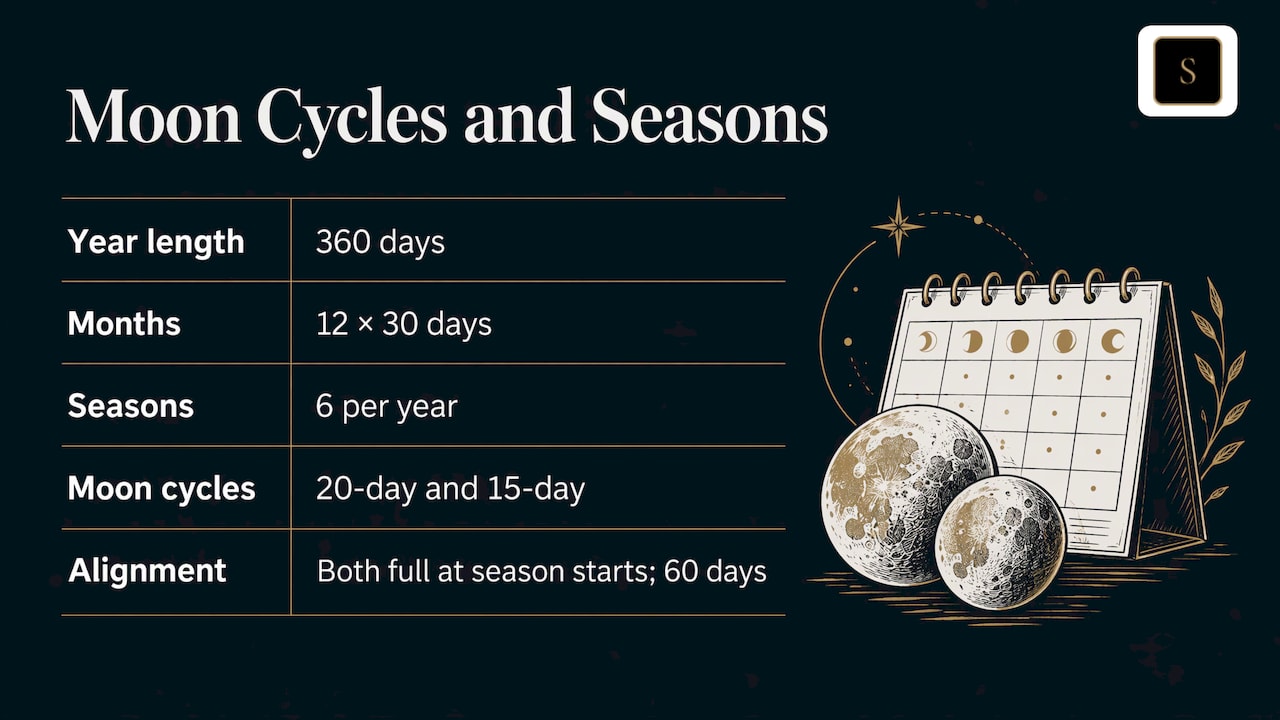
If you want moons, give them cycles that interlock. In the world of Powers and Perils, a 360-day year of 12 thirty-day months is split into six seasons. Two moons run on 20-day and 15-day cycles, and both are full on the first day of every season, resynchronizing every 60 days. The result is a sky that marks the seasons by itself.
A practical rule from the Iloris Novel guide: fix only the astronomical facts the story will lean on, such as year length, number of moons, their speed and whether seasons are even or lopsided. Leave everything finer soft until you need it.
Culture: weeks, months and names
A week is a social invention, not an astronomical one. Your world can have a five-day week, a ten-day “tenday” or no week at all. Ask who set the rhythm: a temple that needed a day of rest, a market that met every eighth day, a monarch who wanted tax days.
Names are the easy part, so do them last. Month names can come from a god, a harvest, an animal or a ruler. If you want a head start on names, our fantasy name generators and god name generator give you candidates to adapt.
History: where year one begins
Every calendar counts from somewhere: a founding, a conquest, a catastrophe, a coronation. Pick that anchor early, because it dates everything else. It also hands you free lore. A people who count years from the fall of an empire are telling the reader something about what they remember.
What famous fantasy calendars teach
You do not need to invent everything. These settings show different strategies, and each one is easy to borrow from.
| Setting | Structure | What it shows |
|---|---|---|
| Forgotten Realms (Calendar of Harptos) | 12 months of 30 days plus five special days between months, and a leap day every four years | Tidy arithmetic with festivals that sit outside the months |
| Wheel of Time | 365 days: 13 months of 28 days plus three special days, with an extra feast every fourth year | Familiar length, unfamiliar shape |
| Discworld | Astronomical year of 800 days, common year of 13 months | Comic mismatch between sky and society |
| Warhammer’s Old World | 400 days, 12 months of 32 or 33 days plus six festive days | Festivals that fall on no weekday |
| Westeros | Seasons last years or decades | Time as a plot engine |
The details behind the table come from several pages. In the Forgotten Realms, the Calendar of Harptos has 365 days: 12 months of 30 days plus five holidays that are real days outside the months, with Shieldmeet added every four years. Months split into three ten-day tendays. Players refer to dates by number and month, such as the 14th of Marpenoth, with years counted in DR, as Alphastream’s timeline article explains.
For the others, Fantasy-Faction’s survey of timekeeping covers the Wheel of Time, Discworld and Westeros. Discworld’s common year begins at Hogswatch on the winter solstice. For Warhammer’s Old World, Kenneth Madsen’s calendar explainer notes an eight-day week with Festag as the day of rest, and that major festive occasions fall on no weekday, which gives them extra emphasis.
Three lessons follow:
-
Round numbers help. Months of 30 days make “three months from now” painless at the table or in a draft.
-
Days outside the months create drama. A festival that belongs to no month feels special, and it is a natural place for plot.
-
Strangeness should cost something. Thirteen months or an 800-day year is memorable, but you will pay in explanation. Spend that cost where it earns its keep.
Make time matter to the story
The strongest calendars are schedules of opportunity, not encyclopedias. The Lore Wiki’s guidance on calendars and festivals suggests marking a small number of events that change what characters can do, giving each a visible sign such as a procession or a closed road, and tying hooks to practical consequences like food, trade, travel, curfews or social permission.
Here is a worked example. Say your world has a 360-day year in twelve months of 30 days, and a river that floods at the start of the sixth month.
-
The festival. The Drowning Week begins on day 1 of the sixth month. Lanterns line the quays.
-
The consequence. Ferries stop for ten days. Grain barges cannot reach the capital.
-
The hook. Your heroine must cross the river before day 10 to deliver a warrant, or the grain price spikes and a rival noble profits.
-
The continuity rule. Every later mention of grain prices, journeys or the capital’s mood must respect those ten days.
One festival, one rule, three story consequences. That is plenty.
For game masters: a calendar that runs offstage
A campaign calendar can do more than name the day. The GM behind Among Cats and Books uses theirs to track injuries and curses, tax and salary due dates, NPC meetings, quest deadlines and offstage events like dungeon restocking and spreading news. For rumors they set a timer: when the date arrives, roll 2d6 to see whether the situation resolved, stayed the same or escalated. Because the world moves while players are elsewhere, their choices ripple outward.
For novelists and screenwriters
Your readers or viewers never see the calendar directly. They meet it through a festival, a character’s age, or the gap between two scenes. Keep an internal timeline in actual days, then reveal only what the scene needs. A screenwriter tracking several storylines across one season benefits most from a single dated timeline that every thread checks against.
What to plan before you use a fantasy calendar maker
A calendar maker is a tool that lets you enter your structure (days per week, months, leap rules, moons) and then displays dates, converts between them and advances time. Whether it is a generator, a desktop app or a template, the same preparation pays off. If you want to try one now, our free fantasy calendar maker runs in the browser, marks full moons and holidays across the whole year and needs no account.
Decide these before you open any tool:
-
Year length and day length. Does the year have a fixed count, with or without leap days?
-
Month and week structure. Equal months, unequal months, days outside the months?
-
Seasons and their start dates. Even or lopsided? Tied to solstices?
-
Moons. How many, how long is each cycle, and which events depend on them?
-
Era and starting year. What is the current year, and what does year one mean?
-
Five to ten dates that matter. Festivals, anniversaries, deadlines and prophecies.
-
Date format. “The 14th of Marpenoth, 1385 DR” or “Day 214”? Pick one and use it everywhere.
One caution that applies to every standalone maker: a calendar in its own app is only half the job. The dates also have to show up in your character sheets, your timeline and your chapters, and a separate file does not update those for you. That is why the SAGALITH calendar maker can save straight into a world's Codex, where the timeline and the date fields of events and characters use it.
Keep dates consistent as the story grows
Calendars usually break at the edges, not at the design stage. A character ages two years in a one-year gap. A festival lands in the wrong season after you adjust the year length. A campaign session says “three days later” and the coronation is suddenly a day early.
A reliable routine:
-
Write the rules once. One page: year length, months, weeks, seasons, moons, era, date format.
-
Put every event on a timeline. Date the founding, the wars, births and deaths, and the festivals that matter.
-
Link, don’t copy. When a character, kingdom or festival mentions a date, link back to the source entry instead of retyping it.
-
Check after every change. If you alter the year length or add a moon, review every dependent date.
-
Back up before big edits. A calendar rewrite touches everything.
This is where a connected workspace helps. SAGALITH keeps characters, kingdoms, family trees, timelines and your manuscript in one place, with linked entries for easy navigation and updates, and a consistency check to help you catch contradictions. The calendar rules themselves go in the World Codex, a rulebook at the top of each world with its own Calendar & eras section for year length, months, weeks, leap rules and how years are counted. Timeline events, characters and chapters can then follow the same rules instead of each keeping its own version. If you want to sketch the structure first, our free worldbuilding template and writing templates are fill-in pages you can use before committing to anything.
Keep your calendar in your story bible
A calendar is one part of a larger system of facts, and those facts have to agree with one another. Birthdays, reigns, journeys and festivals all rest on it. SAGALITH combines a story bible with a character database, maps, family trees, timelines and an integrated manuscript editor, so the world and the draft sit side by side. The fixed rules live in the World Codex: the calendar, naming conventions, currency and trade, and the canon facts every story must respect, plus any rule boxes of your own. If you use the optional AI helpers, they read the Codex too, so a suggested festival or birthday stays inside your calendar.
Every tool is on every plan, and exporting your work is always free, so you can back up or take your entire project with you at any time. AI suggestions are optional, and you review whatever they generate. The Wanderer plan is free, Chronicler is $9 per month and Archon is $19 per month, so Wanderer gives you up to 2 worlds and 50 AI credits a month, and the paid plans add unlimited worlds and more monthly AI credits. You can see the details on the pricing page, or start from the worldbuilding software overview.
Common mistakes to avoid
-
Starting with names. “Frostmoon” tells you nothing about how long it lasts. Structure first, names second.
-
Copying Earth by accident. Seven days, twelve months and 365 days are defaults. Keep them on purpose or change them on purpose.
-
Too many holidays. If every month has three festivals, none stands out. Pick a few that alter behavior.
-
Ignoring the day length. If your day is not 24 hours, hours, ages and travel times shift too.
-
Forgetting the readers. A web or print reader cannot flip to an appendix. Show the calendar through scenes.
-
Changing the rules midway. Fix the core facts early and record any change as an in-world event.
FAQ
How many months should a fantasy calendar have?
Twelve is familiar, but the right number follows from your sky and culture. The Wheel of Time uses 13 months of 28 days, and the Calendar of Harptos uses 12 months of 30 days with five days outside them. Choose the count that makes your festivals and seasons land where you want them.
Do I need moons in my fantasy calendar?
No, but moons are an efficient way to make the sky tell time. If you add them, give each a cycle length and decide which events depend on them. Interlocking cycles, like the 20-day and 15-day moons in Powers and Perils, resync at predictable dates.
How do I track dates across a long campaign or series?
Keep one dated timeline and one page of calendar rules, and link events to both instead of retyping dates. Review dependent dates after any change to the year, month or moon rules. In SAGALITH the calendar rules sit in the World Codex rather than in loose notes, next to the timeline, characters and manuscript in one workspace.
How detailed should a fantasy calendar be?
Only as detailed as the story uses. Fix the facts the plot depends on, such as year length, seasons and a few key festivals, and leave the rest open. You can add detail later when a scene calls for it.
Sources
-
Calendars and Cosmology: Making Calendars Creative (Ludus Ludorum)
-
How to Create a Fantasy Calendar That Keeps a Long Serial Honest (Iloris Novel)
-
Building a Believable Calendar System in Worldbuilding (Behind The Draft)
-
Building a Fantasy World: Geography, Climate, Weather, and Time (Kal Spriggs)
-
The Official Timeline for the Forgotten Realms (Alphastream)
-
Temporal Anomalies: Timekeeping in Fantasy (Fantasy-Faction)