Plotting · · 10 min read
Novel Outlining: A Practical Method That Survives the Draft
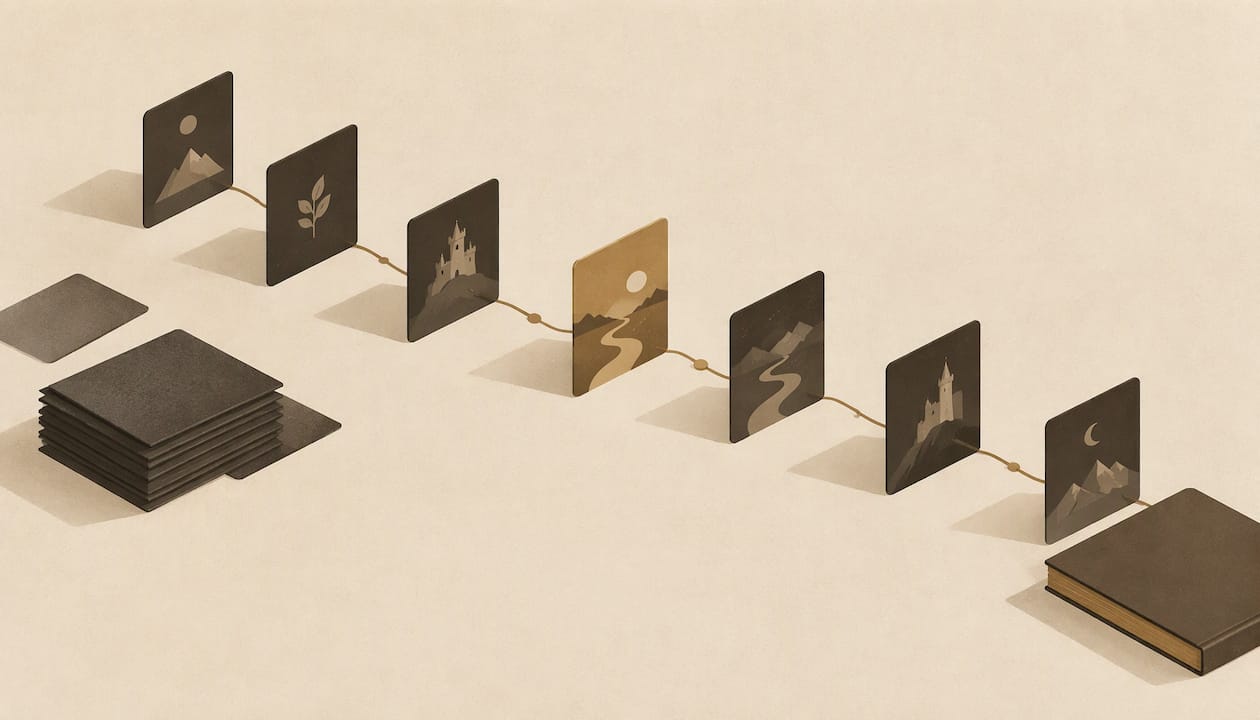
A good novel outline is a short, living plan: a premise, five to seven turning points, and a scene list that you revise as the draft teaches you what the story is. For novelists and worldbuilders, the outline works best when it sits next to your characters, maps and lore instead of in a separate document, which is how Sagalith's novel planning software keeps plot and world linked.
This guide walks through the process step by step, compares the main structures, and shows how much detail is enough.
TL;DR
- Start with a one- or two-sentence premise: who the story is about, what they want, and what stands in the way.
- Pick a structure (three acts, beat sheet, Snowflake, scene cards) and combine methods if one feels too rigid.
- Outline only to the detail that lets you draft the next chapter with confidence, then revise as you write.
- Keep characters, places and timeline entries linked to the outline so a change in one place shows up everywhere.
- Free templates and a free plan let you start without commitment.
Table of Contents
- What a novel outline actually does
- Step 1: Write the premise
- Step 2: Build the people and the stakes
- Step 3: List five to seven turning points
- Step 4: Choose a structure
- Step 5: Turn beats into scenes
- Step 6: Add the world your plot depends on
- How detailed should the outline be?
- What to include in the outline
- Keep the outline alive
- Outline where your world lives
- FAQ
- Sources
What a novel outline actually does
An outline is a plan that gives a draft its structure. The College of Central Florida's library guide describes it as a short path through the story that covers only the main points, useful for keeping information organized and for having something to return to after a long break from writing.
The practical payoff is time. K.M. Weiland argues in Writer's Digest that working out plot and characters in an outline takes a fraction of the time it would take in a first draft, and that it helps you avoid dead-end plot twists. Editorial coach Mary Kole adds that an outline tests whether an idea holds enough material for a whole novel before you spend months finding out the hard way.
For fantasy writers and game masters the benefit is larger. Your plot depends on kingdoms, histories and magic rules. An outline that ignores them breaks the moment a battle happens in a city you have not yet placed on the map.
Step 1: Write the premise
Every outline starts small. Grammarly's outlining guide recommends one or two sentences naming who the story concerns, what they want, and what blocks them. Writers.com suggests one to three sentences that also capture the setting and what makes the story distinctive.
A worked example:
A disgraced archivist in a drowning port city must find the bells that once held back the sea before the council sells the harbor to the people who sank them.
That sentence names a protagonist, a goal, an obstacle and a setting. If you cannot write it, you have found a problem cheaply.
Where it goes wrong: premises that describe a theme ("a story about loss") instead of a person wanting something. Rewrite until someone could act in it.
Step 2: Build the people and the stakes
Before plotting events, know who drives them. Mary Kole recommends outlining the protagonist's objective, motivation, backstory, vulnerabilities and need, and tracking how plot acts on character and character on plot.
This is the first place a story bible earns its keep. Each character entry holds the want, the wound and the relationships, and your outline points to it instead of repeating it. Our guide to building a character database that helps you write scenes shows how to structure those entries, and the piece on character development for characters who change covers the arc itself.
Step 3: List five to seven turning points
Grammarly's method is to list five to seven major turning points and then organize them into a beginning, middle and end. Think of them as the moments after which the story cannot go back: the inciting incident, the first commitment, the midpoint reversal, the lowest moment, the climax.
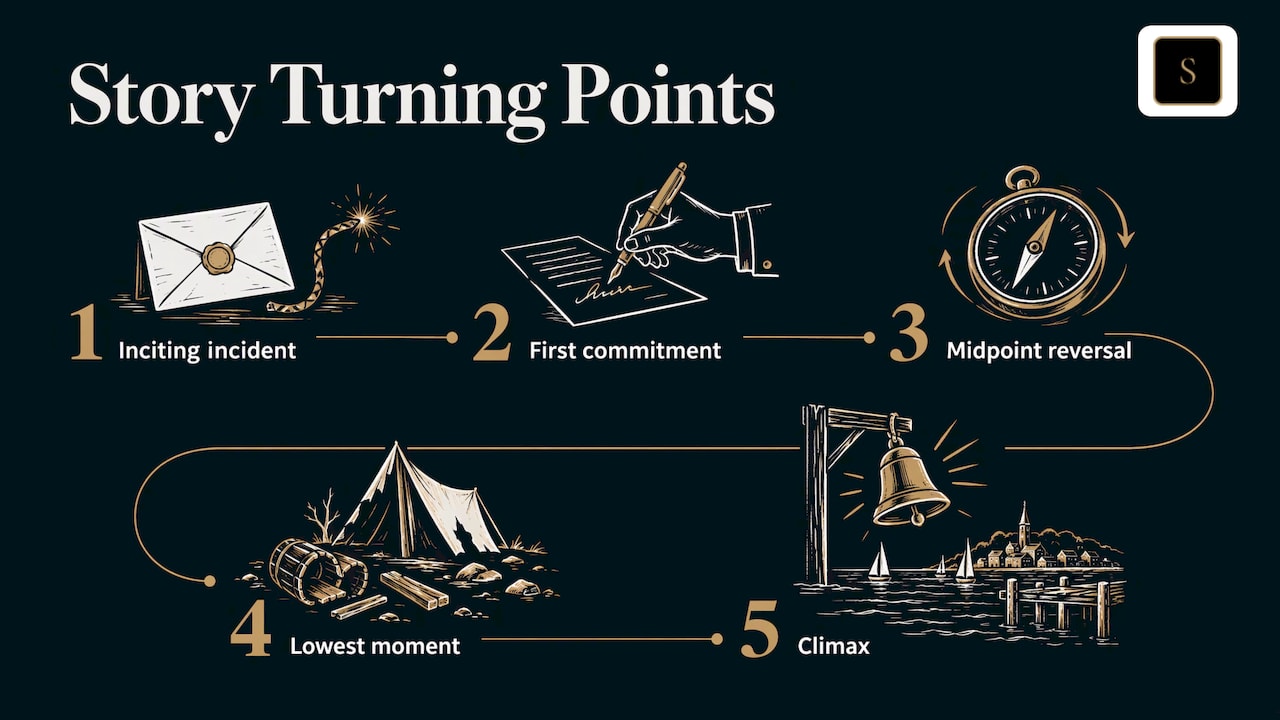
Write each as a sentence with a cause: "Because X, Y happens." If two turning points are linked only by "and then," something is missing between them.
Step 4: Choose a structure
No structure is objectively best. Editor World notes that many novelists combine methods: beats for structure, a synopsis to expand them, then scene cards. The main options:
| Method | How it works | Suits you if |
|---|---|---|
| Three-act structure | Setup, confrontation, resolution | You want a simple frame for a first novel |
| Beat sheet | Named structural beats, scenes filled in after | You like checkpoints and pacing guidance |
| Snowflake | One sentence grows into a paragraph, character work, a synopsis, then scenes | You like building in layers |
| Scene cards | Individual scenes arranged in order | You think visually and rearrange often |
Three acts
Faber Academy describes three acts as setup (establish characters and world), confrontation (develop conflict and a turning point), and resolution (climax, falling action, ending). Scribophile's guide breaks it into exposition, inciting incident, first key plot point, rising action, midpoint, second key plot point, climax and resolution.
Five stages
If you are asking what the five parts of a novel are, the classic answer is Freytag's: exposition, rising action, climax, falling action and resolution. Use them as a check on your turning points: is there an irreversible climax, and is there room afterward to close the story?
Snowflake
The Snowflake method starts with a single sentence and expands it into a paragraph, character work, a one-page synopsis, longer pages and finally mapped scenes. It is slow at the start and fast later, because every scene already has a reason to exist.
Rules are optional
Steven James argues in Writer's Digest that a story need not follow a fixed number of acts. What it needs is escalating conflict and stakes, a seeming-loss moment, a climax, a satisfying conclusion and a transformation. Treat any structure as a diagnostic, not a cage.
Step 5: Turn beats into scenes
Now connect the turning points with scenes. For each scene, write one line: who wants what, what stops them, and what changes. Marissa Meyer favors an at-a-glance outline recording each scene's main purpose so you can modify, rearrange, add or delete material while drafting.
For series, mysteries and anything with several viewpoints, order matters twice: the order the reader learns things and the order they happened. A story timeline maker lets you keep both visible, and a free story timeline planner is a quick way to try it.
Step 6: Add the world your plot depends on
A plot outline answers "what happens." A worldbuilder's outline also answers "where, under what rules, and who knows what." For each scene, note the location, the factions involved and any rule of magic or politics it relies on.
In Sagalith, characters, kingdoms, maps and lore entries are linked, so an outline scene can point to the harbor, the council and the archivist instead of restating them. When you change a character's allegiance in one place, the connected entries are where you look for what else must change. That is the consistency problem a story bible exists to solve.
How detailed should the outline be?
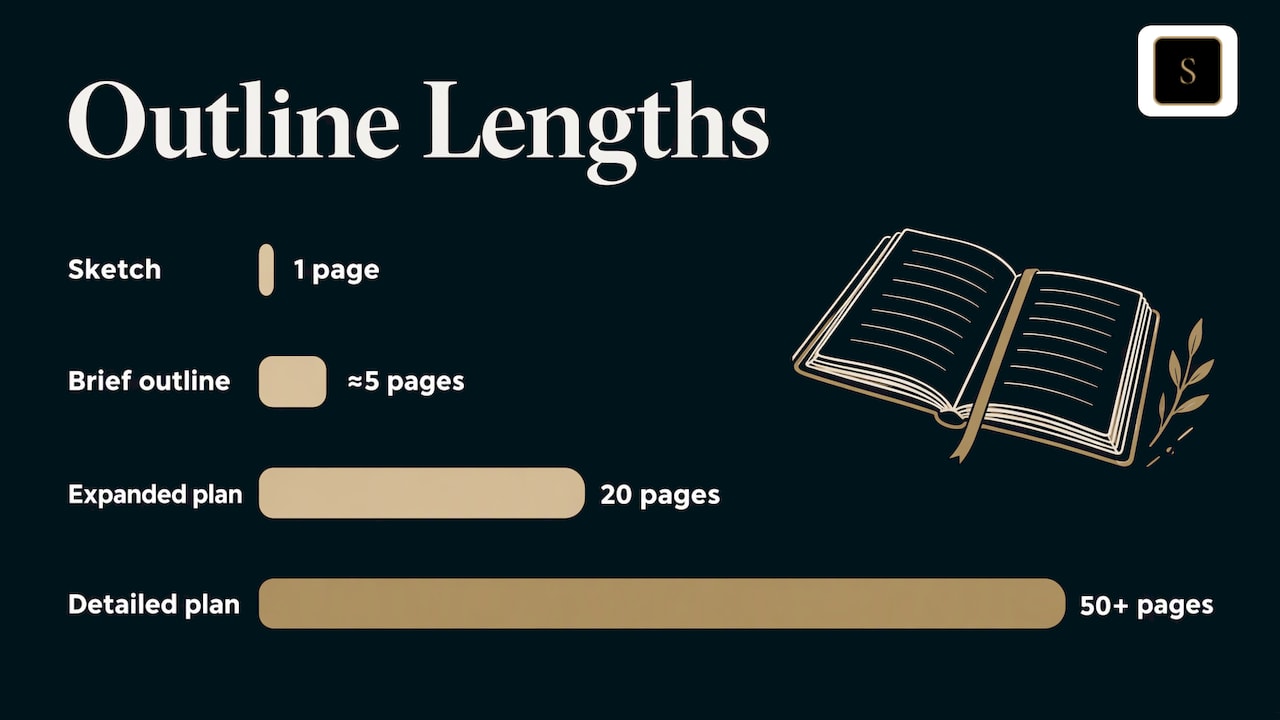
As detailed as you need to draft the next chapter confidently, and no more, according to Editor World. Outlines range from a one-page sketch to fifty pages, at beat, chapter or scene level.
There is a range of workable rhythms:
- Brief: fantasy author Daniel Arenson describes a roughly five-page outline that leaves room to discover the story, at the cost of some restructuring later.
- Detailed: a scene-by-scene plan that can exceed fifty pages, which he calls his personal preference rather than a rule.
- Alternating: the Writing Excuses podcast describes expanding from a pitch to five pages and then twenty, or alternating outlining and drafting, and notes that too much detail can drain the fun from writing.
The library guide mentioned earlier offers a useful reminder: a first outline is typically sparse, with questions left for details you will answer later. Do not let outlining or worldbuilding become a way to avoid writing the book.
What to include in the outline
A workable checklist, drawn from the college library guide and Mary Kole's list:
- Main characters and what each wants
- Setting and timeframe
- Internal and external conflict
- Major plot events in order, with beginning, middle and end
- Subplots
- The theme or idea the story explores
Fantasy writers can add magic rules, factions and the history that pressures the present. Those belong in linked lore entries, not in the outline body, so the outline stays short.
Keep the outline alive
Grammarly calls an outline a living document to update when characters, pacing or subplots change. Weiland frames it as a map: it shows one route, not the only one, and a better idea mid-draft is worth following.
A simple routine: after each chapter, update the outline to match what you actually wrote, then check the next three scenes still make sense. That is easier when your manuscript and outline live in the same workspace, which is how Sagalith's integrated manuscript editor is set up.
Outline where your world lives
Sagalith combines an integrated manuscript editor, a character database, fantasy maps, family trees, timelines and consistency checking in one connected workspace. AI brainstorming is optional, so you stay in control and review everything it suggests. Every tool is available on every plan, and exporting your work is always free.
The Wanderer plan is free, Chronicler is $9 per month and Archon is $19 per month, so Wanderer gives you up to 2 worlds and 50 AI credits a month, and the paid plans add unlimited worlds and more monthly AI credits. See the plans and pricing. To start on paper first, the free novel outline template and the other free writing templates give you a skeleton to fill in.
FAQ
How do you outline a novel for the first time?
Write a one- or two-sentence premise, develop your protagonist and stakes, then list five to seven turning points. Connect them with scenes and organize everything into a beginning, middle and end. Keep it short, because the first outline is meant to change.
How many pages is an 80,000-word novel?
The answer depends on formatting, since font, margins and spacing change the count. For planning, think in scenes and chapters rather than pages: divide your target word count by the number of chapters you expect and check that your outline supports that many.
What are the five parts of a novel?
In Freytag's model they are exposition, rising action, climax, falling action and resolution. They map neatly onto the introduction and inciting incident, escalating complications, an irreversible turning point, the aftermath and closure.
Do I need an outline at all?
Not every writer does, and Weiland describes outlining as brainstorming and discovery rather than merely listing scenes. A light outline gives you direction while leaving room to find the story as you write.
Should I use outlining software?
Software helps most when your story has many linked parts, such as characters, locations and timelines. A tool that keeps them connected to your outline reduces continuity errors across a long manuscript or series.
Sources
- Outline, World-Build, Chapter Summary, College of Central Florida library
- 7 Steps to Creating a Flexible Outline for Any Story, Writer's Digest
- The Power of the Novel Outline, Mary Kole Editorial
- How to Outline a Novel Step-by-Step, Grammarly
- How to Write a Story Outline Step-by-Step, Writers.com
- How to Outline a Novel: Three Methods That Work, Editor World
- How to Plan Your Novel, Faber Academy
- How to Outline a Novel: The Complete Guide, Scribophile
- The 5 Stages of Freytag's Pyramid, Writers.com
- 6 Secrets of Writing a Novel Without an Outline, Writer's Digest
- On Outlines: How Long, How Detailed, How Come?, Marissa Meyer
- Daniel Arenson on outlines
- 12.24: Creating Great Outlines, Writing Excuses
- Should You Outline Your Novel?, Helping Writers Become Authors