Characters · · 12 min read
Enemies to Lovers: How to Write the Trope Well

Enemies to lovers works when the opposition is real, the turn is earned in small visible steps, and the romance changes the plot instead of pausing it. Get those three right and readers forgive almost anything else. Get one wrong and the love story feels either flat or forced. This guide covers what the trope actually requires, how to build enemies who deserve the label, how to pace the shift, and how to keep the whole arc consistent across a long manuscript or a sprawling world.
TL;DR
- True enemies are working against each other, not just competing. Give them at least two of three marks: past harm, a clash of worldviews, or zero-sum stakes.
- Make the hostility legible. Readers should understand why both characters believe they are right.
- Move from hate to love through evidence: competence noticed, costly fairness, handled vulnerability, then a changed instinct.
- If one character harms the other, repair has to cost something, and the hurt character keeps the right to stay angry.
- Tie the romance to the main plot, and track every beat in one place so the arc stays consistent.
Table of Contents
- What counts as enemies to lovers (and what doesn't)
- Make the enmity earn the label
- Escalate the tension without repeating yourself
- The turn: how enemies become allies, then something more
- Handle harm and power with care
- Keep the romance inside the plot
- Track the arc so the turn stays consistent
- Where Sagalith fits
- FAQ
- Sources
What counts as enemies to lovers (and what doesn't)
Book Riot defines the trope as characters who begin as antagonists actively working against one another and end as lovers. It separates this from rivals to lovers, where two people mainly compete for the same prize, and notes that a promotion rivalry like the one in The Hating Game is often mislabeled as enemies to lovers. Rivals want the same thing. Enemies want each other to fail.
Two more distinctions save you from muddled marketing and muddled drafts:
- Circumstantial versus personal enemies. Shannon A. Thompson separates enemies whose antagonism comes from outside loyalties, such as factions or sides in a war, from enemies who dislike each other for individual reasons. Circumstantial enemies are easier to write at first but need personal friction added, or the hostility evaporates the moment the sides are set aside.
- Forbidden is not hostile. The same piece points out that Romeo and Juliet are forbidden lovers who never dislike one another. A feud around the couple is not enmity between the couple.
A quick test: in the first scene they share, does each one try to damage the other's position, plans or reputation? If the answer is no, you may be writing rivals, forbidden love or a banter-heavy slow burn. All are fine genres. They just carry different reader promises.
Make the enmity earn the label
Rants on Romance suggests that high-stakes enemies need at least two of three marks:
- A history of tangible harm.
- An ideological clash over how the world should work.
- Zero-sum stakes, where one character's success requires the other's fundamental failure.
The same guide warns against opening with a secret crush. Readers need to watch friction happen from the first encounter, not be told it is a cover for attraction.
Here is how that looks in a fantasy setting. A harbor archivist who sealed a city's records to prevent a panic, and a smuggler whose family was ruined by that sealing, have harm (the family's ruin) and a worldview clash (secrecy as protection versus secrecy as theft). Add zero-sum stakes by making them both want the same ledger, one to bury it and one to publish it. Now every conversation has a cost.
Give the hostility a legible origin
Write for Harlequin recommends a clear source of hostility, such as a family feud, a workplace betrayal or a past romance disrupted by a revelation. Readers can follow a grudge they understand. A vague "they just don't get along" gives you no scenes to write.
Source the conflict in values, not just personality
Mythcreants lists value differences, conflicting interests, differing experiences and personality clashes as ways to generate conflict between protagonists. Of these, values and experiences tend to hold up over a whole book, because they cannot be settled by one honest conversation. A personality clash alone often can.
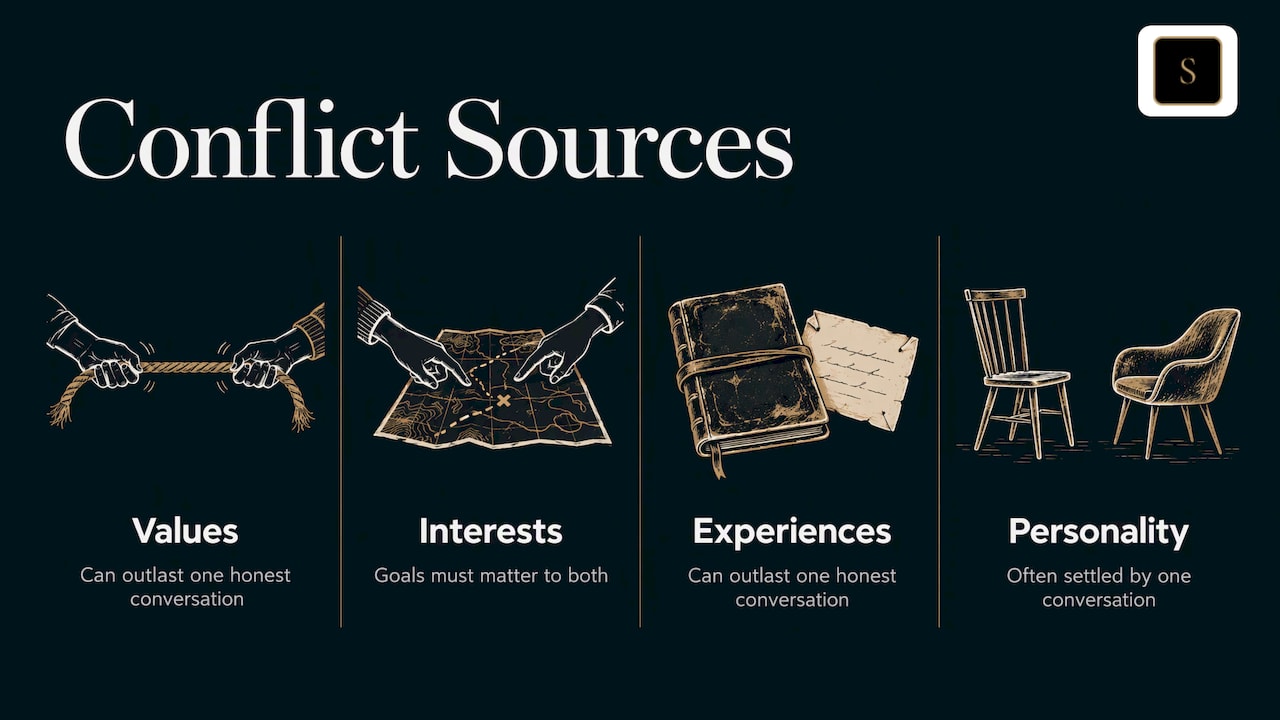
There is a second requirement. Quill&Steel's Rita Melkonian advises that believable enemies have clashing beliefs or goals that matter to both, animosity rooted in betrayal, rivalry or old wounds rather than annoyance, and no purely evil side. Readers should see why each character thinks they are right. If one of them is simply a villain, the later love reads as a reward for cruelty.
Plant a point of connection
The strongest enemy pairs share something they would rather not admit: the same competence, the same fear, the same loyalty pointed in opposite directions. Kerry-Ann McDade describes a point of connection showing the pair could have been allies as one layer of a convincing rivalry. That is your future bridge. Decide it before you write the first fight, and seed it in the second scene.
Escalate the tension without repeating yourself
Book Riot treats high conflict as the driver of anticipation: active opposition, high stakes and a push-pull dynamic keep readers turning pages. The risk in a long manuscript is repetition. Three arguments of the same shape stall the story, even if the banter is sharp.
A practical way to escalate:
- Change the weapon each time. Argument, then sabotage, then public exposure, then a forced alliance. Each round should cost more than the last.
- Change the setting. Move the clash from a council chamber to a road, a ship or a siege, so the pair cannot walk away.
- Let each win cost something. When one character beats the other, show the price they pay for winning. This keeps both sympathetic.
- Add a shared task. Book Riot suggests a difficult mission, such as saving a kingdom, to add plot tension next to the love story. A forced partnership is the classic engine: they have to cooperate while still distrusting each other.
One caution on attraction. Chemistry can be present from the start, but it should show up as awareness (noticing a hand, a voice, a flash of skill) while the characters still act as opponents. The moment attraction becomes an excuse for the hostility to vanish, the tension is gone.
The turn: how enemies become allies, then something more
The most common complaint about this trope is an abrupt switch. Write for Harlequin says a convincing romantic turn needs early groundwork and a compelling reason for the union, and that both leads need growth, including growth apart from the romance, for a fast move from hostility to love to feel credible.
Megan Holley proposes a progression you can use as a scene ladder:
- Recognizing competence. One enemy sees the other do something well under pressure and cannot deny it.
- Costly fairness. One enemy treats the other fairly when it hurts their own position.
- Vulnerability handled well. One sees the other's weak spot and does not exploit it.
- A changed instinct. Where each once reached to wound, each now reaches to understand.
D. N. Bryn distinguishes two situations. In misunderstandings, forced cooperation lets characters show good qualities through action, and it lands best when the other catches them being good with nothing to gain. In cases where the hatred was deserved, a redemption arc has to be witnessed firsthand before gradual acceptance can begin.
The essay by Violamusaraj makes a related point: the turn should begin with evidence, such as one enemy protecting the other unseen, keeping a secret they could have weaponized, or noticing fear beneath arrogance, and respect should arrive before love.
A worked turning-point map
Take the archivist and the smuggler again.
| Beat | What happens | What it shows |
|---|---|---|
| Act 1 | The smuggler steals a key; the archivist has her arrested | Open opposition, both sure they are right |
| Early act 2 | A flood forces them to cross the drowned district together | Competence noticed |
| Midpoint | He could sell her route to the harbor guard and does not | Costly fairness |
| Late act 2 | She finds him rereading names from the sealed ledger | Vulnerability not exploited |
| Crisis | Each chooses the other's goal over their own plan | Changed instinct |
| Resolution | The ledger is published and the seal is lifted, with a price | Love changes the plot |
Notice that nothing in the middle rows is a kiss. The romance is mostly built from choices that make a later kiss believable.
Handle harm and power with care
Enemies hurt each other. That is the trope. The problem comes when cruelty is written as flirtation, or when forgiveness is demanded of the person who was hurt.
Ember's guide on apologies in romance recommends that after harm you show specific accountability, consequences, changed behavior and time for repair, while letting the hurt character stay angry, say no or need time. Violamusaraj adds that where serious harm occurred, repair must cost something, and the responsible character should admit what they did, accept the anger and change without demanding affection as a reward.
Power deserves its own check. LGBT Novel Editorial advises against treating humiliation, slurs, public bullying or repeated consent violations as flirtation. It also suggests mapping who holds power over resources like money, housing, visas or career opportunity, and asking whether the less powerful character can safely refuse or leave. That question works for any pairing, including a commander and a prisoner, a noble and a servant, or a game master's rival NPCs.
A short checklist before you draft the reconciliation scene:
- Does the character who caused harm name it specifically?
- Has their behavior changed on the page, over time, before any forgiveness?
- Can the other character still say no without losing something vital?
- Does the story let anger remain, even after trust returns?
Keep the romance inside the plot
A love story that stops the plot to have a conversation tends to feel indulgent. One that is bound to the plot feels inevitable. Georgia Snelgrove recommends integrating the relationship arc with the story's conflict and structure so the plot does not bend to fit the trope. Book Riot's suggestion of pairing the love story with a difficult task points the same way.
Some ways to do it, depending on your medium:
- Novels: Make the two enemies hold opposite halves of the central problem, so resolving the plot requires them to trade what they know.
- Screenplays: Use the midpoint to flip their positions, so the antagonist's skill becomes the protagonist's only hope.
- Tabletop campaigns: Give two NPCs (or an NPC and a player character) opposed goals tied to a faction conflict, then let player choices shift the balance. Do not script the romance. Offer scenes where trust can be built and let the table decide.
- Fantasy settings: Let the world's politics supply the opposition, and let personal grudges ride on top. A map and a timeline matter here: who could reach whom, and when, shapes what their feud can do. See how to plan a fantasy map around the journey your story needs.
If you want more on how to make a character arc land, the guide to character development for characters who change covers the internal side of what this trope asks of both leads.
Track the arc so the turn stays consistent
This is where long projects usually slip. By chapter 30 you may have forgotten which scene first showed fairness, whether the grudge dates to year 3 or year 5 of the war, or which secret she kept that he does not yet know. Each inconsistency weakens the turn you worked to earn.
What helps is a single place where each character's history, goals, flaws and key beats are written down and linked to the events and locations they touch. A timeline planner is a useful start for ordering the grudge, the harm and the repair. A character database lets you record each enemy's origin of hostility, their shared point of connection and the ladder step they have reached.
A simple tracking sheet for each pair:
- Origin of the hostility and who knows what about it.
- The two or three marks that make them true enemies.
- The ladder beats already shown, with chapter or scene.
- Harm done, who acknowledged it, and what changed afterward.
- Where the romance meets the main plot.
Where Sagalith fits
Sagalith is worldbuilding software that keeps characters, timelines, family trees, maps and your manuscript in one linked story bible. For an enemies-to-lovers arc, that means the feud's origin, the characters' histories and the scenes where trust grows can all point to each other, and the consistency checking is built to flag details that stop matching. The manuscript editor sits alongside your world, so you can check a character page while you draft the turning-point scene.

Every tool is available on every plan, and exporting your work is always free, so your project is never locked in. The Wanderer plan is $0 per month, Chronicler is $9 per month and Archon is $19 per month, with tiers based on monthly AI credits. AI features are optional and you review whatever they generate. You can see the details on the pricing page or start from the worldbuilding software overview.
FAQ
What is it called when enemies become lovers?
It is called the enemies-to-lovers trope. Characters begin as active antagonists and gradually develop respect, then romantic feelings. It is often confused with rivals to lovers, where two people compete for a shared prize without deeper opposition.
How is enemies to lovers different from rivals to lovers?
Rivals compete for the same goal, such as a promotion, and the opposition is mostly professional. Enemies actively work against each other, and the hostility runs deeper, with harm, opposing values or zero-sum stakes. Book Riot notes that stories often called enemies to lovers are really rivalries.
How fast should enemies fall in love?
As slowly as the stakes require. Higher hostility needs more groundwork, and both characters should grow on their own, not only through the romance. Use a ladder of small proofs, such as competence, fairness, handled vulnerability and a changed instinct, before any confession.
Can a villain be a love interest in this trope?
Yes, but the harm has to be taken seriously. The responsible character should admit what they did, accept the other's anger and change over time, without expecting affection as a reward. The hurt character must be free to refuse forgiveness.
Sources
- Your Guide to the Enemies-to-Lovers Trope in Romance, Book Riot
- Enemies to Lovers vs Rivals to Lovers, Shannon A. Thompson
- How to Write Enemies to Lovers That Actually Works, Rants on Romance
- Trope Spotlight: Enemies to Lovers, Write for Harlequin
- Devising Conflict Between Protagonists, Mythcreants
- How to Write Enemies to Lovers Trope, Quill&Steel
- How to Build Epic Rivalries Between Heroes and Villains, Writer's Fun Zone
- Enemies to Lovers Is Losing Its Edge, Megan Holley
- Writing Relationships: Enemies to Lovers, D. N. Bryn
- Enemies to Lovers Without Making Cruelty Romantic, Violamusaraj
- How to Write a Grovel in Romance, Ember
- How to Write MM Romance Without Harmful Stereotypes, LGBT Novel Editorial
- Plotting an Enemies-to-Lovers Arc Without Rushing It, Georgia Snelgrove